Simple tweak alerts you when you've left your headlights on

landrover-headlight-buzzer

[Paul McGuinness] owns a Series III Land Rover, and as the vehicle as formerly used by the British military, it’s lacking some of the modern amenities he was accustomed to. Overlooking the lack of power steering and all-around drum brakes, the one item that [Paul] really missed was a buzzer that let him know when he left the lights running.

On more than one occasion, he’s had to have “The Sarge” jump started after leaving the lights running all day. Explaining the humiliation involved with jump-starting a Land Rover with a Nissan Micra (an unfortunate excuse for a vehicle, known here in the states as the Nissan Versa) in his blog, [Paul] decided that he’d had enough – it was time to build a headlight warning buzzer.

The circuit itself is straightforward, consisting of a normally closed relay connected to his headlights and ignition, along with a buzzer. When the key is in the ignition and the lights are on, the relay is open and the buzzer is silent. However, if the lights are on and the relay is not supplied power from the ignition, it closes and sounds the alarm.

A simple fix for a frustrating problem – we like that.

Adding an electronic lock to a DIY book safe

electronic-book-safe

DIY book safes are well and good, but if you give someone enough time to peruse your book collection, the 3-inch thick “Case study on Animal Husbandry Techniques during the 14th Century” is likely to stand out among your collection of hand-bound “Twilight” fan fiction. In an attempt to teach his friend a bit about microcontrollers and circuits, [Jonathan] spent some time adding a bit more security to your run of the mill book safe.

The pair started out with the time-consuming process of gluing the book’s pages together and creating enough hollow space for both storage and the electronics. With that out of the way, they installed a latch and servo motor inside the cavity, the latter of which is controlled using an Atmega328p with the Arduino bootloader. To gain access to the goodies stashed away inside, Jonathan hooks up a small PS/2 keypad and enters a passcode. This triggers the servo motor, opening the latch.

While the latch likely only adds a nominal bit of security to the book safe, it’s a fun enough learning exercise to justify the time spent putting it together.

Continue reading to see a short video of [Jonathan’s] electronic latching book safe in action.

[Read more…]

Advanced compass/accelerometer library for Arduino

We don’t have much personal experience with DOF hardware, but this Arduino library which reads and compensates for three-axis magnetometer and accelerometer data looks very impressive. It should work for existing hardware, but there’s also a demo design using a Honeywell HMC5883L compass and a Freescale MMA8453Q accelerometer which you can build yourself. Unfortunately these come in QFN packages (like most cheap accelerometers these days) so you may need to be creative when soldering.

What’s so special about this library? Watch the video after the break (use 720p in fullscreen to get the full effect) and you’ll see three different scatter plots of the output data. The image above is a capture of the third example, which is using the hard iron offset and accelerometer compensation. That is to say, metal on and around the board is accounted for, as well as the physical orientation of the device. Even if you have no prior experience with this type of hardware it’s easy to see the usefulness of this kind of software compensation.

[Read more…]

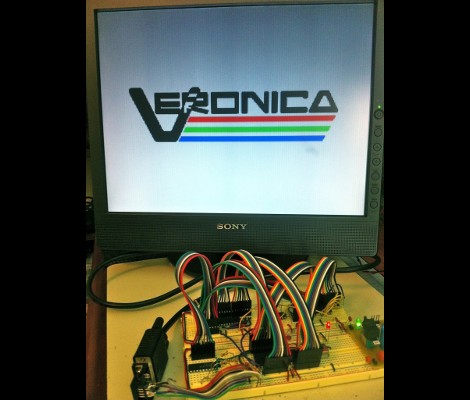
Veronica gets VRAM and its own boot logo

[Quinn Dunki] just reported in on the latest iteration in her computer project which is called Veronica. This time she added RAM to increase the VGA performance of her build. Like just about every other part of the project, [Quinn] knew what she wanted to do, but had to overcome a lot of issues along the way.

The goal is to implement a 256×240 display with 8-bit color depth. [Quinn] says this is on par with game console technology from the 1980’s. The problem is that the 10MHz AVR controller can’t really keep up with the scan rate of this size of display. The answer is to add RAM which stores all of the color data, the microcontroller will simply advance the address pointer on the memory chips to match the sync rate of the VGA output.

After hooking up her hardware design she gets a screen full of uninitialized pixel data. But moving from there to the final product seen above was quite frustrating. It turns out that noise on the breadboard was most of the problem, further compounded by entire breadboard row which wasn’t contacting the wires to make the temporary connections. A bit of jockeying for position and by Jove, she’s got a boot screen.

That breadboard sure has become crowded since her first VGA experiments.

Water Strider robot does it with Lego parts

This Lego watercraft uses drinking bottles as pontoons arranged in a pattern that make it look very much like a Water Strider, the insects that dance on the surface of a lake.

After the break you can see a video of the rig gracefully navigating a local pond, along with a raft of ducks. It’s quiet enough not to startle them, which is nice. We don’t get a good look at the propulsion system, but [Vimal Patel] calls the floats “hockey bottles” in his Flickr comments. They appear to be Lego themed and we’re wondering if they are some type of packaging for a small set that doubles as a sports drinking bottle once the pieces are removed? The rig includes a camera which provides a great persepcive very near the water level.

This isn’t his only floating creation. He’s got a second rig that was used to film some of the footage of this one.

[Read more…]

PS3 IR dongle tamed for use with a Linux box

So a man walks into a Radio Shack and the clerk says “Why the long face?”. No, that’s not it. [Ms3fgx] walks into a Radio Shack and says “holy crap, that PS3 IR dongle is only two bucks”. He’s been looking for an IR remote receiver to use with a Linux machine and decided to bend this PS3 dongle to his will. It’s a lot less expensive that the parts to build the simplest IR receivers like this FTDI cable version, or a microcontroller based receiver.

He plugged it in and was delighted to find that it enumerates. The kernel has PlayStation 3 controller support built-in and has no problem picking up this device. When he uses ‘cat’ to display the incoming data all he gets is repetitive garbage. This is because the dongle only supports Sony remote control codes. But after a bit of universal remote setup, he’s got unique commands for each button. The last piece of the puzzle is to map the controller commands to keyboard keys. This is done with the QJoyPad package, but there are a myriad of ways to remap these buttons so go with what you know.