Retrotechtacular: Introducing the brand new Acorn Risc Machine

Get ready to be swept off your feet by this Acorn Risc Machine promotional video from the Mid-1980’s (also embedded after the jump). We’re sure most have put it together by now, but for those slower readers, this is the introduction of ARM processors.

The video has a bit of everything. There’s a deadpan narration with just a bit of British accent around the edges. But that’s spiced up considerably by the up-beat synthesizer track playing in the background. You’ll see plenty of programmers in short-sleeve dress shirts, and we challenge you to count the number of mustaches that make it on camera. But jest aside, it’s fun to think of how the advent of this chip affected the world.

This post is just the second installment of our Retrotechtacular series (here’s the inaugural post). We haven’t seen any old movies come in from readers yet. What are you waiting for? Digitize that footage because we want to see it! Of course it doesn’t have to be your own movies, so anything you come across that covers decades-old tech is fair game.


[Read more…]

LED matrix shield starts with a very loud snap

We see a lot of LED matrix projects. They’re fun, and you can learn a lot of basic lessons during the build. But this one is out of the ordinary. [Rtty21] built an oddly sized, and sound controlled matrix shield for his Arduino. That’s it right there, the shield is the large chunk of protoboard but you can just see the Arduino peeking up over the top of it.

Now we say oddly sized because a 9×9 matrix doesn’t make much sense with an 8-bit micro controller. There’s no schematic but in the clip after the break he mentions that the columns and rows are driven by a decade counter and shift register and that’s what makes it possible to drive nine bits easily. Also of note on the board is that washer above and to the right of the matrix. It’s a touch-sensitive reset button. But the main control mechanism is a Clapper clone circuit. Just snap your fingers and it turns the project on or off. [Rtty21] based the design on this step-by-step sound input build.

[Read more…]

ATiny powered Kinect fire cannons for dance Fx

[Paul] is at it again with some kinect controlled fire poofers. You may remember [Paul’s] previous shenanigans with the gigantic hand made hydraulic flame-sailed pirate ship.  This time he is building a small flame poofer (possibly a series of poofers) for SOAK, a regional (unaffiliated) Burning Man style festival in Oregon.

Any one who remembers the build will recognize the brains of the new cannons, they are just the pirate ship’s custom ATiny board unceremoniously torn from their previous home and recycled for the new controller. This time though they have Kinect! The build seems to function much like the evil genius simulator by simply using a height threshold to activate each cannon, but [Paul] has plans for the new system. This hardware test uses the closed source OpenNI but will meet its full potential when it is reborn in SkelTrack, which was just released a few weeks ago. The cannons are going to go around a small single person dance floor, presumably with the Kinect nearby.

Check out the brief test video after the jump.

[Read more…]

Playing Pong with your mind

It seems [Charles Moyes] and [Mengxiang Jiang] won’t suffer from the sore wrists and thumbs from an Atari controller any longer. They built a version of Pong played by concentrating and relaxing while wearing an EEG headset.

Right now, there’s only enough hardware for one player; when the player operating the red paddle concentrates the paddle moves up – relax, it goes down.

The hardware portion of the build is fairly tricky business. [Chuck] and [Mengxiang] built a circuit to amplify the tiny voltages between their ears into something a microcontroller can read. The circuit is loosely based on this Arduino EEG build, but highly refined as the elegance of an ATMega644 requires.

The EEG amplifier has a cutoff of under 50 Hz, perfect for reading the Alpha waves correlated with concentration. The oscillations from the skull-cap are sent through the ATMega to MATLAB where after a pass through an FFT the brain waves are converted to mouse scroll wheel output.

There’s a demo video available where you can see spectators screaming at the poor test subject telling him to relax and concentrate on command. You can check that out after the break.

[Read more…]

Arduino BASIC interpreter using LCD, keyboard, and SD

This Arduino BASIC interpreter will make a really fun one-day project if you’ve already got the parts on hand. [Usmar A. Padow] put together an Arduino Uno, SD card, four line character LCD, and PS/2 keyboard. but he’s also included alternative options to go without an LCD screen by using a computer terminal, or without the SD card by using only the Uno’s RAM. As you can see in his demo after the break, this simple input/output is all you need to experiment with some ancient computing.

It’s hard for us to watch this and not think back to an orange or green monochrome display. Just like decades past, this implementation of BASIC has you start each line of code with a line number, and doesn’t allow for character editing once the line has been input. The example programs that [Usmar] shows off are simple to understand but cover enough to get you started if you’ve never worked with BASIC before.

Last August we saw another hack which ported Tiny BASIC to the Arduino. You may want to take a gander at that one as well.

[Read more…]

GPIB connectivity twofer

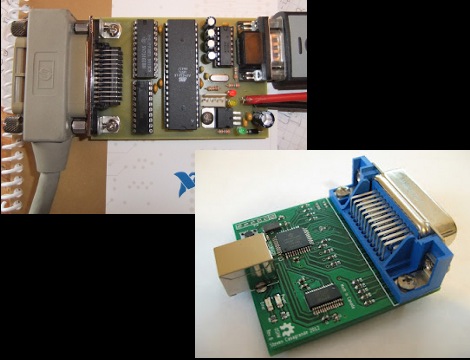
Dust off that old GPIB hardware and hook it up to your modern computing platform using either of these two solutions. If you haven’t a clue what we’re talking about you probably don’t own any fifty-year-old test equipment. But the General Purpose Interface Bus (aka IEEE-488) was fairly common on 1960’s era test equipment like multimeters and logic analyzers.

[Sven Pauli] is responsible for the RS232 GPIB interface board (translated) in the upper left. It uses an ATmega16 and a couple of classic bus driver chips to get the job done.

To the lower right is a USB to GPIB converter board that [Steven Casagrande] developed. This one is PIC based, using the 18F4520 and an FTDI chip to handle the USB side of the equation.

Check out the connector that is used for this protocol. We’d bet that’s not the easiest part to source. But at least now you’ll know what you’re looking at when pawing through the flea market offerings.