Doppler-effect lets you add gestures to your computer

What if you could add gesture recognition to your computer without making any hardware changes? This research project seeks to use computer microphone and speakers to recognize hand gestures. Audio is played over the speakers, with the input from the microphone processed to detect Doppler shift. In this way it can detect your hand movements (or movement of any object that reflects sound).

The sound output is in a range of 22-80 kHz which is not audible to our ears. It does make us wonder if widespread use of this will drive the pet population crazy, or reroute migration paths of wildlife, but that’s research for another day. The system can even be used while audible sounds are also being played, so you don’t lose the ability to listen to music or watch video.

The screen above shows the raw output of the application. But in the video after the break you can see some possible uses. It works for scrolling pages, double-clicking (or double-tapping as it were), and there’s a function that detects the user walking away from the computer and locks the screen automatically.

[Sidhant Gupta] is the researcher who put the video together. In addition to this project (called SoundWave) he’s got several other interesting alternative-input projects on his research page. [Read more…]

The Pirate Bay aims for the clouds…literally

tpb

There is no shortage of government and entertainment-related agencies chomping at the bit to shut down the Pirate Bay for good. While the group has not suffered a permanent service ending raid like [Kim Dotcom] and the Megaupload crew, they are always thinking up novel ways to ensure that the site can endure whatever law enforcement throws at them.

In a recent blog post, representatives from the group unveiled plans to put their front line servers in the clouds, courtesy of custom-made autonomous drones called “Low Orbit Server Stations.” The project is in its infancy, but the general idea is to mount small computers like the Raspberry Pi on GPS-controlled drones kept aloft 24×7 (presumably) using solar energy. These drones would communicate with clients on the ground via radio transmitters which they state can provide a “100Mbps node up to 50km away”.

Calling the claims grandiose would be an understatement, but then again the Pirate Bay has proven to be a difficult organization to quash in any substantial way, so only time will tell.

[via The Daily What – Thanks, roboman2444]

Noise Reduction Techniques for Your Shop-Vac

shop vac noise-reduction setup

Shop-Vacs are great tools, but they do have the notable disadvantage of being loud.  Fortunately, much of the noise emanates from the exhaust, and with a muffler or “silencer”, this can be controlled. The results of my noise-recustion experiments were noticeable, reducing the noise by roughly 5.6 decibels. This may not sound like a huge improvement, but since the scale is logarithmic the sound intensity is actually cut by roughly two-thirds, according to this calculator.

As for how to actually make the muffler, I’ve outlined everything in this post.  As of now, the Shop-Vac muffler is used in a static configuration, but with some changes it could be used on a mobile vacuum.  The disadvantage of this reduction in noise is a slight reduction in suction, but it seems to be an acceptable trade-off in this situation – used for a little CNC router with this adapter.

For a video of the Shop-Vac in action with the CNC router in question, check out the video after the break.  Note that this is pre-silencer, so you can definitely hear the vacuum noise! [Read more…]

Arduino shield includes everything but the kitchen sink

arduino-3g-shield

The crew at Cooking Hacks in Zaragoza wrote in to share a new shield they developed for the Arduino platform. There are a hundred different shields out there that do this and that, but we think their 3G/GPRS shield looks pretty slick.

The base shield contains a WCDMA and HSPA compatible 3G modem as well as a GPS receiver. The modem can be used with an Arduino, or plugged directly into a computer via USB, allowing it to be used any way you like it. The more advanced kit offered by the Cooking Hacks crew features a VGA video camera, as well as an audio kit that can both play and record audio.

One neat feature they were quick to point out is that not all network communications need to be handled by the Arduino. Simple transactions (HTTP/FTP/POP3/SMTP) can all be carried out by sending standard AT commands to the modem.

Now, the kits don’t come cheap, but we can’t help but be interested in seeing what applications people dream up with this shield at the helm. Cooking Hacks is a division of Libelium Communcations, but as they are the company’s “Open Hardware Division” there are schematics available should you be interested in rolling your own 3G modem instead.

Hackaday Links: March 21, 2012

Don’t get your dirty fingers on the glass

[Poke] sent in a video of him using Android devices with a wiimote and PS3 controller. The build uses the Joystick2Touch and the USB Joystick Center app. Root is required, but this will be very useful when tv-sized Android devices start showing up.

Wonderful restoration work

[John] sent in an Instructable on restoring an ancient typewriter. It’s almost beautiful seeing all those delicate metal parts so finely cleaned and reassembled.

Proof of the Big Bang is in one of these articles

[Paleotechnoligist] has been reading the technical journals from Bell Labs. These people were the Google of the 20th century and did some amazing stuff. Here’s the math for getting to the moon and a thing about “cellular telephony.”

Oooohhh extruded aluminum

[Richard Sum] sent us a pic of his new 3D printer kit he’ll be offering soon. Very professional looking.

Flying like a three dollar bill

[Yannick] and [SaakNeMah] sent in this video of a guy strapping on bird wings, running down a field, and then flying for about 100 meters. The project is Human Birdwings and it’s gotten an amazing amount of press coverage. We’re calling fake on this for three reasons: the wings didn’t produce lift, the camera angles are all wrong (only applicable if there was a single flight), and this guy would be a gazillionaire if his wings actually worked. Argue amongst yourself in the comments; we’d love to be proven wrong.

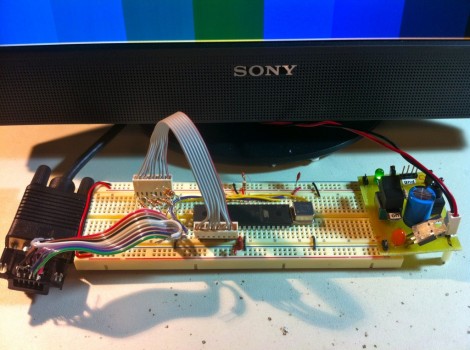
ATmega324 acts as a GPU for homebrew computer

[Quinn Dunki’s] homebrew computer project is moving up another evolutionary rung. She needs a more versatile user interface and this starts with the data output. Up to this point a set of 7-segment digits has served as a way to display register values. But her current work is aimed at adding VGA output to the system.

She starts off her write up by justifying the protocol choice. Although composite video would be easier to get up and running (we see it in a lot of AVR projects) [Quinn] doesn’t have a screen that will display composite video. But there’s also a lot of info out there about VGA signal generation. She delved into the specifics and even found a great AVR-based example over at Lucid Science.

The version seen above uses the 40-pin ATmega324. It’s a lot bigger than necessary for the example she put together, but in the future she plans to add video memory and will be glad to have all of those extra I/O pins. When it comes to video sync, timing is everything. She wrote the code to drive the display using assembly. In this way, she was able to look up the cycles used for each command to ensure that the loop is running with near perfect timing.