Rain barrel irrigation system keeps your plants fed when you're too busy

sprinkler-controler

[Kyle Gabriel] moved into a house with a nice tract of land behind it, but due to his busy schedule he had yet to plant the garden he so desperately wanted. He worried that his hectic life and busy hours would lead to accidentally neglecting his garden, so he built a water collection and automated irrigation system to ensure that his plants never went without fresh water.

The system is fed by two large 55 gallon barrels that collect rain from his gutters. A 1/2 HP well pump is used to pressurize the collected water, which is then dispensed throughout his garden by a sprinkler. [Kyle’s] system is run from a small control box where an Arduino is used to control the pump’s schedule. At a predefined time, the Arduino turns the pump on, while monitoring the system for potential problems.

If the system starts running low on water, the Arduino triggers the valve on his spigot to open, keeping the water level above the pump inlet pipe. He also keeps an eye on pump’s outlet pressure, indefinitely disabling it before a blockage causes the pump to cycle repeatedly.

He says that the sprinkler system works quite well, and with his modular design, he can add all sorts of additional functionality in the future.

Glue Stick + Servo = Linear Actuator

glue stick linear actuator

What do you get when you cross a glue stick with a hobby servo motor? A linear actuator, of course! Although this could be done with other household implements, the form factor of this glue stick seems perfectly suited to sit on top of a servo horn.

The servo, as you might have guessed, has to be converted to rotate fully instead of the 180 degrees or so that is typical of these types of motors. The trick to this, and what really makes it shine in our eyes, is that instead of attaching two resistors in a normal continuous rotation mod, the potentiometer is used on the glue stick allowing for position feedback.

The resulting force from this gear-reduced actuator is quite impressive, giving an “err” (over 3 Kilograms) on the scale used for testing. [Gareth] or [Chiprobot] gives a great tutorial of how to make one of these after the break, but if you’d rather just see it in action, skip to around 8:20! [Read more…]

V-Synch detector lets you use 3D shutter glasses on Linux systems

This circuit is how [John Tsiombikas] makes his cheap 3D shutter glasses work with a Linux machine. It’s not that they were incompatible with Linux. The issue is that only certain video cards have the stereo port necessary to drive the head-mounted hardware.

Shutter glasses block light from one eye at a time, so that different renderings can be shown to create the stereoscopic effect. Since stimulating the muscles in the eye doesn’t actually work, you need to find a way to drive the glasses in perfect time with the video signal. His circuit watches for the V-Sync signal, then uses it to toggle the shutter glasses. Since the hardware has no way of knowing whether the left or right frame is being generated, he included the toggle switch as a user-controlled adjustment. If the 3D isn’t coming together, you’re probably viewing the frames with the wrong eye and need to flip the switch.

There’s really no way to show the effect without trying out the hardware in person. But [John] reports that it works like a charm when used with the OpenGL stereo wrapper.

Android on your netbook

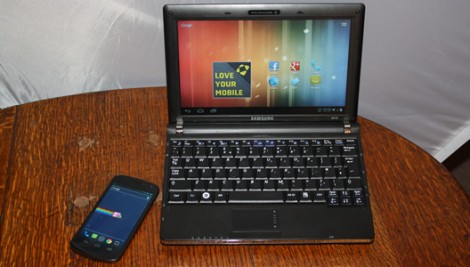
Looks like there’s a pretty easy way to install Ice Cream Sandwich, the newest version of Android, on your Netbook. Actually this is limited to a few types of hardware including netbooks like the eeePC. That’s because the ISO files used during installation have been tailored to the hardware used on those devices. As with other Linux distros, the ISO file can be loaded on a thumb drive using Unetbootin. From there you can give it a whirl as a Live CD (or USB as it were) or choose to install it on your hard drive. We haven’t given it a spin as the eeePC version doesn’t want to boot on our Dell Mini 9, but we don’t see a reason why this couldn’t be set up as a dual boot option.

Now why would you want to run Android on your netbook? We’ve already seen that there’s a way to run Android apps in Ubuntu. We bet some people just love Android, and others just hate the Unity desktop that Ubuntu now uses… especially when the Netbook Remix had a lot of good things going for it.

Coin cell battery charger

[Jay Kickliter] built his own coin cell battery recharger. This won’t work on the vast majority of coin cells as they are manufactured as disposable parts. But there are rechargeable options out there with model numbers that start with LR instead of CR. In this case he tailored the charging circuit around MCP73832 IC and chose components best suited for charging his 110 mAh LR2450. But we believe all of the LR options out there are rated for 3.6V so altering his design for use with different models should be a breeze.

We’ve been unhappy with the use of disposable coin cell batteries for some time. Sure, in a real-time clock where the cell might last 6-8 years this is not very wasteful. But in an Apple TV remote that gets a lot of use, we hate the choice of a disposable battery. All of our less-hip remotes which use AA or AAA have NiMH rechargeables in them and have used the same pair for year and years. So we’re happy to see this charger project come along.

Now the bad news. We looked around and indeed you can find LR2032; a rechargeable replacement for the CR2032. But the capacity rating falls way flat. The model we looked at boasts only 50 mAh while the disposable CR2032 offers something along the lines of 240 mAh. Hopefully this will change as battery tech evolves.

ATtiny44 drop-in replacement for Ikea Dioder's stock PIC controller

The Ikea Dioder is an LED light sold at the big blue and yellow building that lets you mix your own colors using a simple button and wheel controller. [Marco Di Feo] looked at all of the other projects out there that alter the controller and figured out that the IC can be directly replaced with an ATtiny44 microcontroller. With that chip soldered onto the board he added IR control so that he can change colors using his universal remote control (translated).

[Marco] removed the potentiometer normally responsible for selecting the color. This frees up one pin on the microcontroller which he then uses to receive signals from a TSOP1736 IR receiver. The video after the break shows the device, which illuminates the back of his home entertainment center, reacting to commands from his remote control.

Of course this can be done without the chip swap as the PIC 16F684 that comes with it can be reprogrammed in place. But [Marco] didn’t have a PICkit or other programmer on hand. [Read more…]