Working software-defined radio with a TV tuner card.

[Balint Seeber] just sent in a small yet timely project he’s been working on: a software radio source block for the Realtek RTL2832U. Now with a cheap USB TV tuner card, you can jump right into the world of software-defined radio.

[Balint]’s code comes just a week after hackaday and other outlets posted stories about using a $20 USB TV capture dongle for software defined radio. At the time, these capture cards could only write data directly to a file. With [Balint]’s work, anyone can use a cheap tv tuner dongle with HDSDR, Winrad, or GNU Radio. If you’ve ever thought about trying out software-defined radio, now might be the time.

Elsewhere on the Internet, a surprisingly active RTL-SDR subreddit popped up dedicated to using the Realtek RTL2832U tuner for software defined radio. There’s an awesome compatibility chart listing compatible USB dongles. The cheapest (so far, and subject to change) is the Unikoo UK001T available for $11 on eBay.

With his source block, [Balint] can listen to anything on the radio between 64-1700 MHz. The sample depth is 8 bits and the sample rate can be anything up to 3.2 MHz. You can watch [Balint] testing out his $20 GNU Radio rig after the break.

[Read more…]

Quieting an inexpensive bench power supply

[Mike] just purchased this Atten APS3005S bench power supply for around $80. It does the job, but boy is it noisy! We were pretty surprised to hear it fire up in the video after the break. To make matters worse, the noise is persistent since the fan never shuts off. Having worked with other bench supplies he knew that a common feature included in many models is temperature controlled case fans. He set out to quiet the fan and implement a temperature switch.

For this project [Mike] had the benefit of looking at a nearly identical model that does have temperature switching. He discovered that the board on this one has a through-hole zero ohm resistor populated in place of a thermostat switch. That switch closes the connection at or above 45 degree Celsius, thereby turning on the cooling fan. Bridging the traces with a zero ohm resistor to save on production costs is what caused the fan to run continuously. After replacing the resistor with a KSD-01F and swapping out the stock fan for a high-quality version [Mike] has takes a noise maker and turned it into a device that’s kind to the ears.

[Read more…]

808 camera hack produces a time-lapse Tic Tac box

It’s not really conceived as a spy cam, but it could be. [Quinn Dunki] built this tiny time-lapse camera project with racing in mind. She’s involved in a group that endurance races clunkers, and part of the fun is sharing the experience of riding around in the old beaters. The module seen above takes a picture every four seconds and will last 24 hours before needing new batteries or an SD card change. We wonder if that’s longer than some of the ‘racecars’ make it?

She picked up an 808 camera, which looks like the key fob you use to unlock your car doors. They’re so cheap you can include them in projects and not really care if you don’t get them back. Inside it’s got a small lithium battery, the circuit board with a processor, microSD card slot, and of course the SSD used to capture the images. To control the device she used a tiny relay with an ATtiny13 used for the timing. We think the battery selection is a bit overboard, but maybe the next version will be a little more conservative.

There was one folly along the way. She wanted to attach this to the body of the car with a handful of magnets. But they don’t play nicely with the magnetic relays so that was out. The solution was to add that lanyard ring to the case which will allow the camera to be zip tied to the vehicle. So far there are no time-lapse movies available, but keep your eyes on our links posts and we’ll try to include one when it pops up.

Sentry gun controller-board upgrade

This open source sentry gun controller board builds on a great concept by getting rid of the Arduino board. The previous version was an Arduino shield, but this upgrade keeps all of the cool features by rolling the necessary parts into one smaller footprint.

The image above doesn’t quite convey the scope of the project. Go take a look at the feature from last year which used the shield version of the controller. That build used a servo-mounted paintball gun in conjunction with a webcam. You can still build the same platform, but use the open-source files to include this board. It has outputs for three servo motors, and can also interface with airsoft or paintball guns which have their own electronic triggers and integrated batteries.

We always like to see the schematic for projects like this one. For your convenience we exported an image from the Eagle package. You can find it, along with the demo video, after the break.

[Read more…]

Trumpet Hero

[Evilsigntist] combined an old cornet with an old PS2 guitar hero controller to produce the Trumpet Hero. The fragile looking conglomeration really brings a smile to our faces. Just make sure the instrument has already seen the end of its days before drilling holes to mount the various parts.

In the image above you can see that the three valve buttons have been painted to correspond to frets on the original guitar controller. The orange and blue frets are positioned for the left hand to operate. There seems to be a couple of different version because there is a diagram showing a mute in the bell that can be twisted for whammy bar input, but that’s not shown here. Strumming is accomplished by blowing through the mouthpiece, but as you can see in the video after the break, no buzzing is necessary.

Using actual instruments as game inputs is a lot of fun. We always think back to the flute and drum set controllers for Rock Band.

[Read more…]

Tricorder project brings the fabled devices into existence

Whether or not you love Star Trek we’d bet you know what a Tricorder is. The handheld device capable of gathering information about the environment around you, or taking health diagnostics about an injured crew member, seemed like unfathomably advanced technology when first seen on the original television series. But our technology has advance so quickly that you can now build a Tricorder of your own. That’s exactly what [Peter Jansen] has done. He founded the Tricorder project as a way to put a useful scientific instrument in the hands for the curious masses.

In the promo video embedded after the break [Dr. Jansen] gives us a recap of his progress so far. Three versions of the project have already been produced, and a fourth is under way. The first iteration could take atmospheric, spacial, and magnetic readings. This covers things like temperature, humidity, GPS data, light intensity, and distance measurements among others. Housed in a dark grey case it looks much like the original prop.

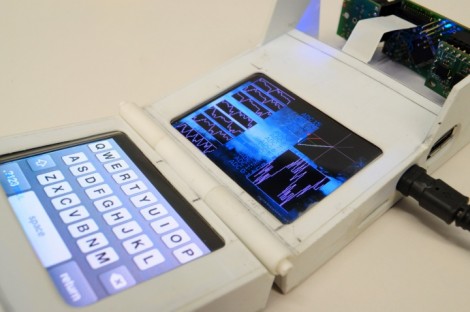
The second model, which is seen above, implements a swapable sensor board. That’s the part hanging off the top, but the finished model will enclose that part of the case. The hardware on this is fantastic, using an ARM processor running Linux and two 2.8″ OLED touchscreen displays. But both of these models have a price tag that’s just too high for widespread use. He’s been working on two more, the Mark 3 and Mark 4. The most recent is in software development right now with the hopes of mass production when all the details are worked out.

There’s a lot of info to dig through on the project’s site. It’s open source and all the goodies we usually look for are there.

[Read more…]