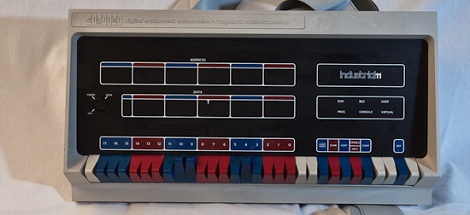
Controlling blinkenlights with modern computers

A few old timers may remember that once, long ago, computers didn’t require keyboards. The earliest personal computers such as the Altair 8800 and the server rack-sized minicomputers like the PDP-11 could be controlled with a panel filled with switches and lights, giving us the term blinkenlights. Today, most of these machines have been thrown away or locked up in museums and private collections; even if you were to get your hands on one of these control panels, you’ll have a heck of a time doing something useful with one.

Fear not, because [Jörg] has come up with a great way to control these blinkenlights and simulate the computers of yesteryear. He calls his build BlinkenBone, and it’s able to control the blinkenlight panels from dozens of historical computers and simulate every thrown switch and tiny light bulb.

BlinkenBone is a BeagleBone single board Linux computer running the SimH simulator for antique computers. Right now the BlinkenBone is able to simulate the PDP-1, PDP-8, PDP-11, a lot of old IBM machines, the Altair 8800, and even some HP boxes.

Without a BlinkenBone or similar simulation device, the still-surviving control panels for these computers are just pieces of art to hang on a wall. When they’re running a simulation of their original hardware that was long-lost to the scrap yard, they become the useful devices they once were. Also, it’s much easier to appreciate how far technology has come in the last 40 years.

You can check out a short demo of [Jörg] using his BlinkenBone on a PDP-11/40 after the break. Look at those lights go.

[Read more…]

Lego Mindstorms used to automate tedious laboratory tasks

lego-bone-machines

Modern society owes so much to medical research, though what happens behind the scenes in a laboratory is usually far less than glamorous. A group of scientists at the University of Cambridge are working to develop synthetic bone tissue, but the process to create the samples used in the study is incredibly tedious.

To make the bones, a substructure must be dipped in a mixture of calcium and protein, rinsed, then dipped in a mixture of phosphate and protein…hundreds and hundreds of times. Equipment that can automate the process is available but very cost prohibitive, so the scientists did what they do best and built a set of robots to do the work for them.

Their new bone manufacturing setup was constructed using Lego Mindstorm kits, which were a perfect solution to their problem in several ways. The kits are relatively cheap, easy to construct, easy to program, and able to perform the same function precisely for days on end.

Now instead of burning time manually creating synthetic bone samples, the group can focus on the more important facets of their research.

Continue reading to see a video presented at the 2012 Google Science Fair, showing how everything came together for the crew at Cambridge.

[via Make]

[Read more…]

A 3D Pantograph

pantograph

It seems that there is no end to ingenious woodworking tools, such as this 3-D Router Pantograph from [Woodgears.ca]. The pantograph, a design using linkages to trace and scale drawings, may have been invented in the 1600s, but if we were honest, most of us haven’t heard of this device. This particular pantograph is able to trace letters or other stencils in three dimensions by pivoting about an additional axis.

If you’re wondering where to get these stencils, they’ve got you covered with an online stencil generation tool. However, if you want to make even more detailed stencils, we might recommend using a free drafting tool such as Draftsight (here’s a review), or Sketchup.

[Woodgears] gives a good explanation of how it’s made in the video after the break. You can also buy plans for it if you want templates to use to cut everything. [Read more…]

Ethernet over telephone wire

When [Bobo1on1] upgraded his Internet connection from ADSL to Fiber he ran into an issue of actually getting that speed to his desktop computer though his LAN setup. Before he had been using a telephone extension wire which ran from where the DSL entered the house, through a splitter, to his computer where the modem was located. Now that the router used by the fiber system is located at teh entry point, he has no easy way to run Ethernet cable to his computer room. Wifi is predictably slower than the 50mbit WAN connection, and he was unable to use the telephone cable as Ethernet directly.

The solution turns out to be a pair of TP-Link home plug adapters. These are designed to use your home’s mains wiring for data transfer. But [Bob] rigged it up so that they can push 224 mbits/sec over the telephone wire. Since you can’t run mains voltage through the telephone wire he had to hack a method to separate power for the devices from the data I/O. This was done with an external power supply and some passive components for filtering. The drawback is that this is half-duplex so up/down communications cannot happen at the same time.

Steam fife

This auto-flute does it with steam. Well, electricity gets its piece of the action too as the tone holes are opened and closed using a set of solenoids.

We’re at a loss on how the sound is actually produced. We would think that a penny whistle has been used here, except if that were the case the solenoid nearest the kettle would have no use. Then again, after watching the demo after the break we’re not sure that it does have much of an effect. It may be meant to stop the sound but it doesn’t really work all that well.

At any rate we’d love to see some spin-off hacks. Assuming the plastic can stand up to the steam heat this would be a perfect robot controller for recorder controlled snake. You can get a recorder for a buck at the right dollar store, and solenoids can be made out of simple materials. If you know of a way to produce the sound yourself, all it takes are a few careful calculations to place the tone holes.

[Read more…]

Robotic whiteboard writes your wall on the wall

[Dave’s] drawbot writes his Facebook wall messages on a whiteboard. The setup is pretty simple, depending on a pair of stepper motors and common household goods. As you can see in the image, the stylus is a plain old dry-erase marker held by a big spring clip (the kind that holds a stack of papers together). What you can’t see is that there’s a kick stand to hold the writing head away from the board when moving to the next plot point.

In this example a cursive font is being used, but [Dave] included two other fonts in the code. Those require the felt tip to be frequently lifted from the board, and a servo motor does this by pressing a cotton swab against the surface. This does erase any marker lines it slides past, but it’s a pretty small area that is lost. To control the motors [Dave] is using the EiBotBoard which was originally designed for the EggBot. It’s got a USB mini-b connector which lets a computer push messages scraped from the Internet. Don’t miss the video demonstration embedded after the break.

A small modification would make this into a pretty nifty light painting rig.

[Read more…]