Light programming for a clock

+

So at first glance we were thinking there wasn’t much special about this clock. It’s based on an Arduino and displays the time using a character LCD screen. But then we realized that there’s no battery-backed RTC and no buttons. How the heck do you set the time on this thing? [Mossblaser] is using a light programmer to set the time using a computer screen.

We’ve tried nearly the same data transfer technique before, using a white and black flashing computer screen to push Manchester encoding to a light dependent resistor. We were met with limited success, but you can see that [Mossblaser’s] rig is much more reliable and we think there’s a few reasons behind this. First, he’s only sending five bits per seconds, a very slow speed when it comes to digital transmissions. This helps to make up for slow LCD screen refresh. Also, the LDR is surrounded by material on the back of the case that will help to block out ambient light. And finally, he’s using a smaller part of the screen instead of flashing the whole thing. This may result in more accurate timing. You’ve got to admit, this is pretty slick!

[Read more…]

There's more than meets the eye to this robot car

This is a robot that any Transformers enthusiast will love. Sure, the car looks just a bit boxy, but you’ll forget all about that when you see it unfold into a bipedal robot (translated). [Zak Sawa] is responsible for the creation. He pull off the build using 22 servo motors which let the car transform, and provide the somewhat awkward ability to walk. Fold it back up again and the car can drive away. In other words, here’s the Transformers toy that you always wanted; radio controled and it actually works!

This is the result of about four years of work. Apparently it’s the eighth iteration, and a note on the video after the break teases a ninth version on the way. It’s not just the robot that looks great, check out the carrying case that houses it for storage.

[Read more…]

RC car controller and receiver replacement

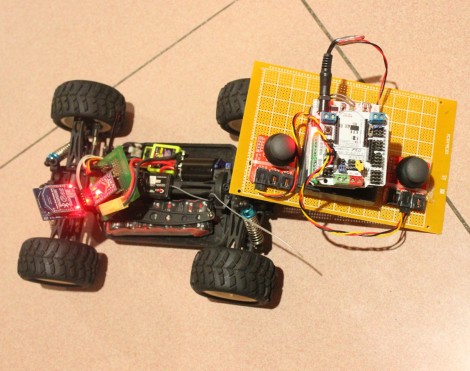
This radio controlled car controller replacement is a great project to try some new things with that fancy hardware you’ve got sitting around. The hack comes in two parts, the receiver and the transmitter. They’re communicating via Bluetooth so if you only want to build one side of the hardware you should be able to make most Bluetooth devices work as the other. For instance, build the receiver for the car and control it with a Wii remote. Or use the controller to play emulator games on an Android phone.

Both pieces are Arduino based. The controller makes use of a Freeduino with a Bluetooth shield as well as a pair of analog stick breakout boards. The car side of things uses a Bluetooth Bee (a Bluetooth module that is pin compatible with an Xbee socket) and an Arduino pro. Once the hardware bits are assembled, it takes very little code to get the system up and running. Join us after the break for a quick clip of the car in action.

[Read more…]

Wristwatch measures your perception of time; also tells time

This wristwatch is hiding a lot of features in its hardware and its software. It’s called the TicTocTrac and it’s a Senior project for a pair of students at Cornell University. Judging from the sheer volume and quality of the project documentation we wonder if someone has a science writing career ahead of them? Be we digress… It’s a clock and we love it!

First off, this does more than just tell the time. In fact, that’s almost an ancillary function in this case. The wristwatch is more of a metering device to record your own time-based behaviors. Find yourself checking your watch frequently as the lunch break approaches? This watch records that activity and you can later graph the data. This allows you to analyze how you percieve the passage of time. The more often you check the time, the slower you feel time progressing. The documentation does a much better job of describing this than we have time for, so check it out.

On the hardware side of things we’re quite impressed. The housing is 3D printed. It hides two half-circle PCBs below the full-circle PCB face plate. The half-boards leave space for a tiny rechargeable battery, and host a vibrating motor and RTC chip. Instead of using buttons, there’s a piezo sensor which detects when you tap on the top of the watch.

You might be a geeky dad if: your kids practice spelling in Morse code

Kids learn better if they’re engaged in the topic at hand. [Todd] found something that has his son just begging to practice his spelling words each night. He converts them all to Morse code and taps each out on the Morse code practice station they built together. To start off Todd connected the keyer to his Fluke 87 meter, using the continuity tester to sound a beep each time the key is depressed. But this is just a temporary setup until [Todd] could help guide his young one through some circuit design and assembly.

The replacement is based on a 555 timer. They grabbed an electronics project book and found the schematic along with a Morse code primer. With parts in hand [Todd] films as his son hones his soldering skills with each connection. The finished project uses the timer chip to produce the audio frequency heard from the on-board speaker. If you’ve never had the joy of teaching a kid how to solder, you’re going to love seeing the video.

[Read more…]

A Clockwork Useless Machine Prototype

usless-machine-mechanical-clockwork

Most of us have seen the [Useless Machine] where a switch is flipped and a finger comes out to turn it off, retreating into it’s box again. Most of those are electrical, but why not a [Useless Machine] made only of mechanical clockwork? Apparently this has been done before, but why not one more?

After some rough, sketches, and almost no research, I finally “came up with” a way to do this mechanically. A small wheel acts as the driver for the assembly, which is weighed down by a T-handle attached to a string wrapped around it. When released, this smaller wheel fully rotates causing the larger wheel to rotate up around ninety degrees then come down again. In reality, the flipped switch doesn’t reverse the motion of the finger at all, it instead stops it from cycling over and over. The video after the break may explain it a bit better.

This machine currently is a prototype. Although it works well without a lid on at simply reversing the switch, it’s much too fast and isn’t capable of lifting any sort of weight. Like a lid to come out of, for instance. This whole assembly was made possible with my CNC router and inexpensive/easily machineable MDF. [Read more…]