Motorcycle engine hack like having an old F1 between your legs

The difficulty of rolling a 16-cylinder engine into a motorcycle really boggles the mind. But that’s exactly what [Andreas Georgeades] is doing in his garage. It’s two straight-8 engines sandwiched on top of one another with a custom crankcase connecting them. And get this, those custom parts are being milled by hand, using time-tested techniques rather than modern computer assistance.

So, where does the complexity come in? Well first of all you’ve got to solve all of the problems that go along with combining two engines. It sounds like this isn’t a new concept, as older generations of Formula 1 engines used the technique. But we still think it’s the pinnacle of hardcore when it’s an enthusiast undertaking the challenge. Then there’s the issue of weight. The engine is bulky, but needs to balance in the frame. And you still must find a way for the rider to sit on the thing (even the most bow-legged of people won’t be able to get their hips around the thing).

Seems like something out of a Mario Kart game that should have no chance of being roadworthy. But we’re sure [Andreas] is going to prove us wrong.

[Thanks Th3BadWolf]

Reprogramming promotional USB dongles to launch custom URLs

webkey-hacking

The teachers at [Jjshortcut’s] school were each given a Webkey by the administration as a promotional item of sorts, but most of the staff saw them as useless, so they pitched them. [Jjshortcut] got his hands on a few of them and decided to take one apart to see what made them tick.

He found that the device was pretty simple, consisting of a push button that triggers the device to open the Windows run prompt, enter a URL, and launch Internet Explorer. Since the microcontroller was locked away under a blob of epoxy, he started poking around the onboard EEPROM with his Bus Pirate to see if he could find anything interesting there. It turns out he was able to read the contents of the EEPROM, and since it was not write protected, he could replace the standard URL with that of his own web site.

While it’s safe to say that without a new microcontroller the Webkeys probably can’t be used for anything more exciting than launching a browser, [Jjshortcut] can always reprogram the lot and drop them in random locations to drive some fresh traffic to his web site!

[Thanks, Wouter]

Check it out, my clothes are electric. No, seriously

Someday you may be able to use your crotch or armpits to recharge that cellphone. Heck, maybe there won’t even be a battery, just a capacitor which gets its juice from Power Felt, a fabric that converts body heat to electricity.

Now we mention the nether-regions because it’s funny, but also because it makes the most sense. Researchers have developed a fabric containing carbon nanotubes used in a way that generates electricity based on a temperature differential. We figure the areas on the body that have high heat loss would be the most efficient locations for the fabric since it is currently extremely expensive to produce (the hope is that mass-production would reduce cost by orders of magnitude). So we think battery-charging briefs are a definite possibility.

What we see here is a nano-scale Peltier electricity generator. It’s the same concept as this candle-based generator, except the increased efficiency of the Power Felt lets your wasted body heat take the place of the flame.

There’s a white paper on the topic but you can’t get at it without surrendering some [George Washingtons].

[via Reddit and Megadgets]

Shoulder mount for any camera

Whatever your reasons may be, if you’re going to be holding a camera for long periods of time this shoulder mount will both steady the image, and help save you some aches and pains. [Kyle Jason] built the rig seen above for just $20 by following this guide.

[Knoptop] published the guide about a year ago. It doesn’t make use of any special PVC connectors, so you’ll have no problem finding everything you need at the hardware store. Connectors used include 45 and 90 degree angles, straight pieces, and a PVC conduit box to serve as the mounting bracket. After cutting, dry fitting, and welding everything together the rig really benefits from a couple of coats of paint. Don’t forget the grip covers to make the thing easy to hold onto.

Don’t want to read the build guide? After the break you’ll find [Knoptop’s] build video which is actually quite a fun eight minutes to watch.

[Read more…]

Doubling up on the USB supercap flashlight

[Antoine] wrote in to let us know that he soldiers on with his flashlight project. He’s doubled up on the supercaps and tripled the LEDs (translated).

The core concept has stayed the same since the original version. He wanted a flashlight that was small and used no batteries. This iteration came about as he looked at increasing the light output of the device. He’s switched to some warm-white LEDs which are easier on the eyes, but was unhappy with the charge life now that he’s using current at a faster rate. The solution, of course, is more potential from the capacitor. He’s now using two 10 Farad caps in parallel. We are a little skeptical about his capacitor theory and ended up using this lecture to defog the issue of parallel and series capacitance.

The upgraded hardware is right at home in that plastic egg like you’d find in a coin-op trinket vending machine. You’ll see there’s still a colored LED to warn when the charge is getting too low.

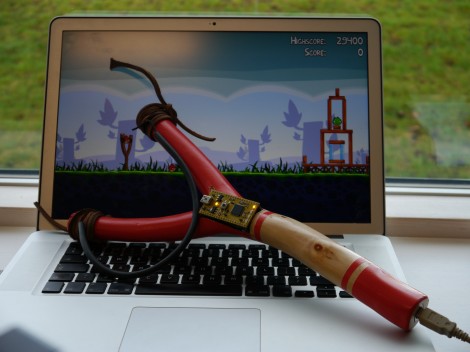
USB slingshot controller is for the birds

This USB slingshot controller really brought a smile to our faces. Part of it is the delightfully silly promo video you’ll find after the break. [Simon Ford] combined nature and technology to bring this USB-enabled slingshot into existence.

The frame itself is from a branch he found in the Epping Forrest of London. He whittled away the bark, and hollowed out an opening in at the base of the ‘Y’ to receive an accelerometer board. It has a pair of female pin headers to interface with the mbed seen in the image above. But the real hack here is the code he wrote to translate accelerometer data into appropriate mouse movements. His success in the area makes this translate the virtual world of Angry Birds in a visceral experience of killing things with a slingshot.

We’re suckers for this type of project. Two examples that pop into mind are these musical instrument hacks for Rock Band 2.

[Read more…]