Hackaday Links: April 20, 2012

Introducing Hackaday: how it’s made edition

Ever wonder how the make the forms for marine propellers? Now you have. It turns out they use a bunch of plywood, Bondo, and sandpaper. Awesome viewing for a coffee break.

Finally a new way to hurt yourself!

[Darrell]’s solder flux pen was filled and capped at sea level. When this pen made it to his work bench high in the mountains of Colorado there was a significant amount of pressure in that pen. The flux squirted out right into [Darrell]’s eye. Better get some Visine on that, man.

The most accurate television portrayal of hacking ever

[Russell] was watching TV last night and saw an interesting commercial. It’s a bunch of electronic components, then a nook color showing the front page of Make: Projects, an Arduino schematic, and finally a happy robot. Two observations: firstly, someone in media and advertising doesn’t think ‘hacking’ is WarGames stealing bank accounts. Secondly, an ad exec looked into current users.

Here’s the official YouTube video of the commercial.

In a world… where components aren’t soldered… one man… uses a soldering station.

Adafruit linked to the most outrageous promo video ever. This Weller soldering station provides 240 watts, battles alongside Agamemnon at Troy,  has rework tweezers, and travels to Italy to wage war against the Latins.

An IDE for the 21st century

[Chris] is currently developing a new paradigm for programming. He calls it Light Table, and it’s designed to be an improvement over a simple text editor and project manager. All the documentation is at your fingertips, you can make changes on the fly. It reminds us of the zzstructure emulator we saw last year. It’s something to keep an eye on at least.

Tearing down a colonoscopy pill camera

Normally, colonoscopies are rather invasive affairs. Swallowing a small pill with a camera is much more amenable to a patient’s dignity and are seeing increasing usage in colon cancer screening. [Mike] acquired a pillcam from a relative who underwent the procedure and did a teardown to figure out how it works.

To get the video signal out of the body, the pillcam has two contacts that conduct the video signal through the body to stick-on contacts; It’s a more power efficient way of doing things versus a radio transmitter. After opening the plastic and metal capsule, [Mike] found three batteries and an impressively small circuit that contained an array of LEDs, a camera, and what might be a small MCU.

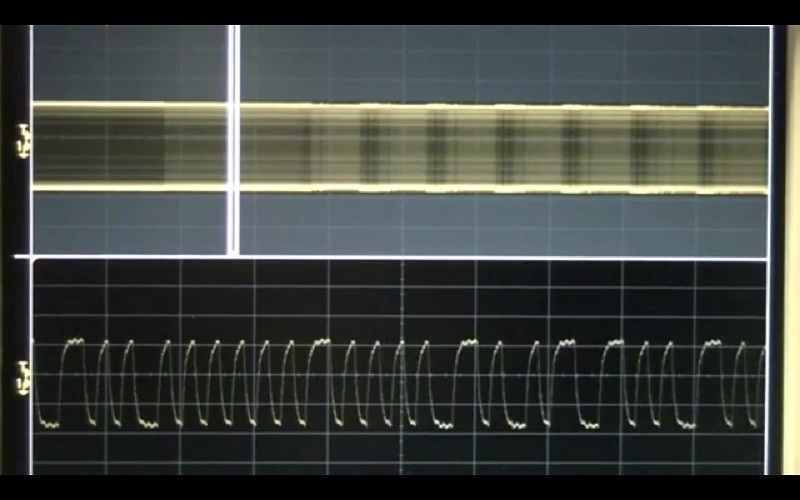
Taking a scope to the electronics in the pill, [Mike] found an impressively complex waveform that sends uncompressed image data to the receiver every few seconds. Although the camera was somewhat destroyed in the teardown, we’re pretty confident [Mike] could decode the image data if he had another… ‘sample.’

[Mike] says if you can ‘retrieve’ another one of these pill cameras, he’ll gladly accept any donations and look into the differences between different makes and models. Just make sure you sanitize it first. After the break you can see [Mike]’s teardown and the inevitable poop jokes in the comments. One last thing – if you’re over 50, doctors should be looking at your colon every 5 or 10 years. Get screened.

[Read more…]

Spend your weekend contributing to the exploration of space

Earlier today we posted a link to a tournament NASA is holding. NASA is trying to crowdsource the organization of terabytes of data collected from missions all over the solar system. A few Hackaday readers wrote in (thanks [grbgout] and all the others) to tell us there is an International Space Apps Challenge going on this weekend to crowdsourse solutions to the problems of space flight.

The challenge is the product of a partnership between NASA, the National Science Foundation, the UK  and Japanese Space Agencies and a host of other organizations like GitHub, Yahoo Developer Network, and even a few hackerspaces. The idea behind the challenge is simple: spend a weekend solving software, hardware, and science challenges to improve the state of space sciences.

There are a lot of interesting projects like programming an interface to a NASA mission simulator, figure out how to print 3D objects in space, and even develop the hardware and software for an underwater ROV.

Aside from the fancy software and hardware challenges, there are also some very interesting data visualization problems, like clearly explaining the fact that space is mostly empty. If you can figure out how to tell people they aren’t the center of the Universe, take a shot at it – there’s probably a Nobel in Literature in it for you.

Right now there are dozens of locations on all seven continents and in Low Earth Orbit (McMurdo Station in Antartica and the ISS) that will have people contributing to these projects. Of course you’re free to work out of the home and help scientists, engineers, and researchers reach to the stars.

Improving a freestyle kayak

When [Andrea] was looking for a freestyle kayak, he bought the cheap version of a high-end kayak. The hull is exactly the same as the high-end model, but to differentiate between product lines, Pyranha chose to use less expensive fittings. [Andrea] decided to bring his new kayak up to spec (Italian, here’s a Google translation) by fixing the problems in the cheaper model by bringing it up to more professional standards.

When [Andrea] got a hold of his kayak, the back rest was held on by a piece of nylon webbing secured with a plastic clamp. This was bound to fail after just a few outings, so he fixed this with a few steel nuts and bolts. The eyelets used to tie ropes to the kayak were terrible, so with a little bit of nylon webbing and a pair of buckles these were replaced.

Now, [Andrea] has a very nice kayak indeed, for less than the price of the more expensive version. Good job, [Andrea].

Do anything with the help of lucid dreaming goggles

In the world of your dreams, you can build an entire world, an entire universe, an entire society governed by your every whim. While lucid dreaming you are a god in your own mind, free to create or destroy at will. You can train yourself to recognize when you are dreaming, but sometimes a little technological help can speed you towards the path of becoming an old testament god. [Will] over at revolt lab built a set of lucid dreaming goggles so he could take control of his own dreams.

To induce a lucid dream, [Will] took a pair of safety goggles and attached red LEDs to shine into his closed eyes. A simple circuit was constructed out of an ATtiny85 that blinks the LEDs two hours after being turned on. The idea is these LEDs will be noticed by the user during REM sleep and they will realize they’re still sleeping. After that, it’s basically Inception.

It is possible to induce lucid dreaming through psychological and not technological hacks; just asking yourself, ‘am I dreaming’ throughout the day may be enough to make a holodeck in your mind while you’re sleeping. You can check out a video of [Will] wearing his goggles after the break.

[Read more…]

Building the mind of a robot overlord

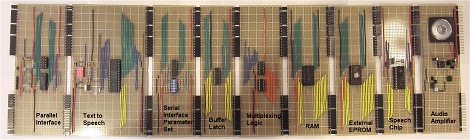
The folks at the Louisville hackerspace LVL1 now have a fabulous piece of wall art that is also a speech synthesizer. The speech synthesizer is over two feet long and is made of nine panels of stripboard connected with right angle headers. An awesome piece of art if there ever was one.

This speech synthesizer is actually 30 years in the making. In the early 1980s, one of the members of LVL1 across a few text-to-speech ICs in a bin in Radio Shack. These ICs sat in a drawer while college got in the way, and in 1990, the project was resurrected. The speech synth chips sat in a drawer for another decade, and it was finally decided to build a wall-mounted speech synth for LVL1.

This speech synthesizer is intended to be the voice box for FATHER, LVL1’s second hackerspace AI. Already the first AI – MOTHER – is already telling people to take out the trash and generally trying to become the AI-gone-amok we all deserve. FATHER will be implemented in a robotic monkey, so right now the only question we have is who has been messing with the Louisville water supply.