MIT Students take Tetris to a grand scale

Careful, this hack might foster doubts about the level of fun you’re having at you own Computer Science department. Last weekend a group of students at MIT pulled off a hack of great scale by turning a building into a Tetris game board.

The structure in question is the Green Building on the Massachusetts Institute of Technology Campus. It houses the Earth, Atmospheric, and Planetary Sciences Departments, but was chose based on the size and regularity of the grid formed by the windows on one side. The group hasn’t provided much in the way of details yet, but the video after the break shows the game play and start-up screen. The middle portion of the building is used as a scrolling marquee to display the word “Tetris” before the game pieces start falling. We’re only guessing (and we hope you will add your conjecture in the comments section) but we’d bet they assembled a set of wireless RGB LED lamps and set one on the sill of each window. There does seem to be a number of ‘dead’ pixels, but it doesn’t diminish the fun of the overall effect.

If you don’t have your own building to play on, you should go small-scale and implement Tetris on a character display.
[Read more…]

Cheap and easy linear supported rail

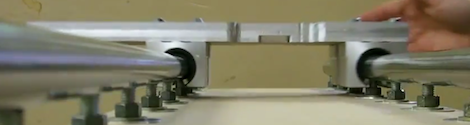
Some of the very largest – and coolest – CNC machines use supported linear rail for their movement axes. For any home tinkerer trying to reproduce these supported rails, the problem of cost comes up very quick; these rails can run over $100 for just a few feet. [Michael] came up with a great way to build his own supported rail so he can build his very large CNC router.

There aren’t many tools needed to build [Michael]’s rail. He put a 90° notch in a 2×4 to support his 25mm rail, and clamped it down with a piece of plywood. After drilling a 5/16″ hole every 12 cm, he tapped these holes out to receive 3/8″ threaded rod. Yes, we also hate the mix of metric and imperial units in that description, but the results speak for themselves.

The now-supported rail was mounted to a piece of MDF with a few bolts and washers. MDF isn’t the most dimensionally stable material, so [Michael] will be covering the whole thing in a coat of epoxy very soon. Now, he’s one step closer to his gigantic CNC gantry router.

You can check out [Michael]’s demo video after the break.

[Read more…]

Finding your keys with Bluetooth

[doragasu]’s wife is always misplacing her keys. To solve this problem, [doragasu] created a small Bluetooth-enabled key fob that is able to remotely sound an alarm when commanded to by a cell phone.

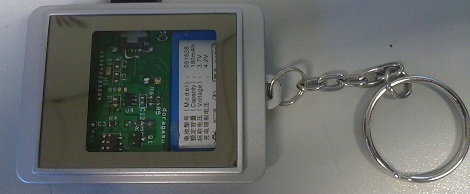
The case and LiPo battery of [doragasu]’s project comes from a small photo frame key fob. The LCD display and PCB of the photo frame were tossed aside for a future project, and the design of the circuit started. The Bluetooth buzzer key fob is based around an MSP430 microcontroller because of their extremely low power requirements.

On the software side of things, [doragasu] built a J2ME app to connect to the key fob and turn the buzzer on. His app is portable to any Android phone, and versions can be ported to Windows, OS X and iOS devices.

How does it work? Well, [doragasu]’s wife sometimes forgets to charge her key fob, rendering the whole project useless. There are ideas for  updating the device to a Bluetooth 4.0 Low Energy device, but no actionable plans. Still, very good work. You can check out [doragasu]’s walkthrough and demo video after the break.

[Read more…]

Stop Motion Animation Creation

PVC man stop motion animation

Stop Motion Animation has always been interesting to me since I “discovered” that one could make animated flip books by drawing each frame a little different. Fast forward 20 years or so, and computer technology has gotten to the point where this sort of thing can be done electronically quite easily and at an incredibly low price of a camera, computer, and free or paid-for software (here’s the technique using GIMP, a free, good quality photo editing tool) to put everything together.

The frames in the picture above are of my latest [PVC man] animation, which can be made with some electroluminescent lights, gloves, and some PVC pipe.  Each frame was individually photographed, and after several hours of work we had enough footage for 17 seconds of so of stop-motion animation.

Although by no means perfect, the quality of these animations has gone up dramatically from the first animations that I made using an old ENV2 camera phone. Although I was using a “custom mount” for it, it’s amazing these came out as well as they did. As with everything hacking related, this process is a constant work in progress. Check out the videos after the break for the [PVC man] video as well as one of the early ENV2-produced stop-motion shorts!

[Read more…]

Automated bed leveling with our 3D printer

Anyone with a RepRap or other 3D printer knows how much of a pain leveling the bed is. To get a good quality print, the bed – the surface the printer prints on – must be exactingly level, and may the engineering gods help you if your surface has the slightest bump in it. [Atntias] is developing a solution to this problem: an auto leveling platform that shouldn’t require any parts at all if you already have a metal bed.

The idea is incredibly simple: Just ground your metal bed, and apply a small voltage to the tip of your hot end. [Atntias]’ code (available on GitHub) probes the surface of the bed and shoots out a 3D mesh of your current bed profile. This can be used as a GCode offset, so the bottom of your print is always directly on the top of the bed.

Although the utility of leveling a bed down to the micron level is of questionable utility for 3D printers, it’s vitally important if you want to mill a PCB on your printer. [Atntias] says his idea is currently being implemented into the Marlin firmware, so it looks like another firmware update is in our future.

Thanks go to [technodream] for sending this one in. Check out the video after the break to see the bed leveling process in action.

[Read more…]

Building new interfaces with an iPad

There’s a word – synchronicity – to describe two disparate events that occur together in a meaningful way. We see this a lot in the Hackaday tip line; two people send in somewhat similar hacks solving similar problems in similar ways nearly simultaneously. Here’s two builds by [Bryce] and [spektakx] that hit our inbox within minutes of each other that both implement existing interfaces with iPads.

iPad turntable controller

[spektakx] sent in an iPad powered DJ MIDI controller he built as a prototype to test out the size, orientation and layout for an upcoming build. The turntable controllers are simple USB affairs made to jog and scratch records digitally. Although [spektakx] admits it’s a little unfinished, it’s still just a prototype. Also, he can use a Windows 7 tablet laptop for ‘more suited’ hardware. Check out [spektakx]’ video demo after the break.

an iPad cash register

[Hacktheory] found [Bryce]’s Flickr photolog of a DIY ‘Square’ cash register. The electronics part of this build is practically non-existent; it’s just an iPad with a credit card readers that plugs into the headphone jack. Yes, we just saw these ‘Square’ credit card readers this last week. The fabrication portion of this build is incredible – [Bryce] has a few wonderful pieces of walnut there, and did an exceptional job with the wood work. It’s probably not well suited to high-volume retail, but we couldn’t think of a better cash register for a boutique shop.

[Read more…]