A.R.T. sorts your recyclables for you

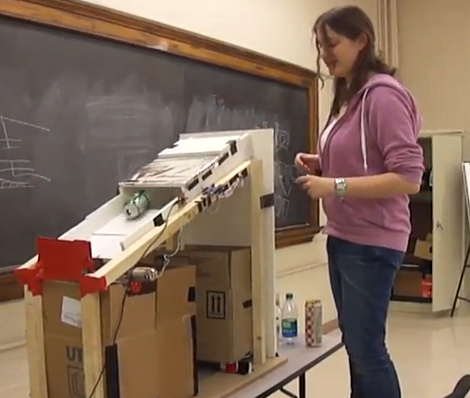
[Yuhin Wu] wrote in to let us know about the Automated Recycling Sorter that was built with a group of classmates at the University of Toronto. They entered it the school’s student design contest and we’re happy to report that it took first place.

The angled sled has been designed to separate glass, plastic, and metal containers. The first sorting happens at the intake area. A set of moment arms are used to weed out the glass bottles. Since there are several of them in a row, a larger and heavier plastic container will not be falsely sorted and the same goes for smaller glass bottles.

With the glass out of the mix the team goes on to separate metal and plastic. An Arduino was used for this purpose. It senses an electrical disturbance caused by a metal can passing through the chute and actuates a trap door to sort it. Plastic has no effect on this sensor and slides past the trap to its own sorting bin.

Don’t miss both demo videos which we’ve included after the break.

[Read more…]

Using routers as displays

Have you ever seen an LED display made out of routers? [Sean] took eight Netgear routers and made an 8×4 display out of them. Because that wasn’t cool enough, a very small version of Conway’s Game of Life was added to the build.

Each router is running a copy of OpenWrt, a Linux distro meant for limited hardware. Instead of an 802.11 protocol, each router runs the B.A.T.M.A.N. advanced mesh protocol. This protocol allows each router to communicate with all the other routers.

Instead of each router receiving data from a master, the routers calculate each step in the Game of Life independently.  Once the routers communicate their initial states, each router is responsible for displaying its four LEDs for each new generation. In the video after the break, you can see [Sean]’s routers calculating random Game of Life boards. Sadly, we didn’t notice a GoL oscillator being randomly generated, but with a 4×8 play field even a Glider wouldn’t last very long.

[Read more…]

Weekly Roundup 2/4/12


Another week has come and gone and that means that it is time for our week in review. These are the top posts that have been viewed at Hackaday in the past week.

Coming in at first place is a post about a project by [Red Jones] and [Brian Kast] of Sandia labs. Ethical issues aside, this is a pretty cool project. They have developed a bullet that can be shot out of a smooth-bore gun that can hit within eight inches of a target one kilometer away. That is pretty amazing. It does this magic with an 8-bit processor. This takes the microcontroller wars to a whole new level. Are they using Microchip, Atmel or (gasp) something else?

In second place is a follow up post to our post asking how to control three LEDs with three switches, all in series. That post, although it was posted in December 2011 came in at number three. Getting back on topic though, this week’s post shows how he did it! Not only that, but it shows the extent that he went to when making it. There is footage through the eyepiece of a microscope showing him building one!

Want to use LiPo batteries in your next project but are afraid to use them? Here is a post where [Paul] shows off a circuit that he built that can charge LiPo batteries using a MCP7813 chip from Microchip.

Finally, rounding out the five is a post about a blog that was taken down but luckily not before the IEEE made a copy of it. This blog was made by a robot operator working at the Fukushima nuclear plant and detailed their ongoing cleanup operations there.

Office game show buzzer keeps things fair and square

office-game-show-buzzer

The sales team in [Chuck’s] office is a pretty competitive bunch as you might expect, and they decided that they wanted a system which would allow them to challenge one another during their weekly meetings. The competition involves answering questions posed by their manager, but hand raising only works for so long – they needed a definitive way to tell who “buzzed in” to answer a question first.

Since [Chuck] only had a short bit of time and a tiny budget to work on, he opted to find the easiest solution to the problem, which was an Arduino-based game show buzzer system. The game display is built from an Arduino, some LEDs and an Altoids tin, while the buzzer pushbuttons were salvaged from an old radio broadcast console.

Now, when a question is posed, the salesman can buzz in to answer, knowing that only the quickest person’s button click will be registered. When it’s time for another question, the host simply clicks his buzzer to reset the console.

While it’s not quite as fancy as this game buzzer system we featured a while back, [Chuck] says it does the job perfectly and was cheap to boot.

Continue reading to see a short video of the office game buzzer system in action.

[Read more…]

Coffee table puts on a show behind smoked glass

This coffee table is a real show-piece. It’s got a smoky glass surface that is hiding the LCD screen within. But what fun would it be if it could only play video? The rest of the enclosure houses all the parts necessary to make this living room centerpiece into a computer.

After the break you can see a video showing off each step of the build process. It starts by ridding the screen of its enclosure, and using what’s left to determine the size of the wood frame for the table. With the display firmly in place [Nate] sets to work position, mounting, and developing cooling solutions for the motherboard and the rest of the bits. He does nice work and ends up with a table that we’d be proud to feature in our homes.

Now he’s got a lot of computing power and a huge display, but isn’t something missing? How hard do you think it would be to add touch sensitive input to this? We’re wondering if the overlays used to make those Android touchscreens could be mounted on the underside of the glass?  [Read more…]

Reclaim the wireless controller module from a broken Xbox 360

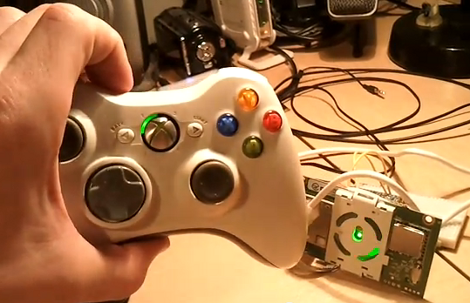
If you’re one of the hordes whose Xbox 360 died the fiery death associated with the RRoD you may be wondering what to do with that multi-hundred dollar door stop you’re left with. Why not salvage the parts for other uses? If you’ve ever wanted to use your wireless controller with a computer here’s a way to pull out the RF module and reuse it.

The concept is simple enough, there’s a daughter-board in the Xbox 360 which hosts the RF module for wireless controller connectivity. Once you extract it from the carcass of the beast, you just need to find a way to read and push the data to your computer. Any USB enabled microcontroller will do, in this case an Arduino nano was chosen for the task. A bit of level converting was necessary to interface with the device, but nothing too involved.

It sounds like at first there was an issue with syncing a controller with the hacked module, but as you can see in the clip after the break that problem has been solved.

[Read more…]