Hackaday Links: February 19, 2012

Industrial control robot band

Remember Animusic, a series of videos featuring computer-generated, highly  implausible instruments? Intel made their own to demo their industrial control tech. From the looks of things, we’re putting money on a bunch of MIDI triggers bolted onto plastic panels; now it’s slightly less impressive and the reason we’re looking at xylophones on eBay right now.

Quadrocopters everywhere

[Jouni] sent in his quadrocopter build that was inspired by the Japanese spherebot we caught earlier this year. [Jouni] used a carbon fiber frame to  prevent the copter from bumping into things. Other things bumping into it are another story entirely.

This is my gun. There are none like it, because I printed it.

[Landru] printed a Nerf gun on his 3D printer. The only non-printed parts are a few screws, springs and an o-ring. [Landru] promised to put the files up on Thingiverse, but we can’t find them.

Media center auto power on circuit

[Dizzy]’s media server doesn’t have an ‘AC power loss reset’ feature in its BIOS, and he can’t jumpstart the thing by shorting pins on the ATX power socket. He came up with a very clean, minimal solution to starting his server after a power loss. Nice job, [Diz].

Better run, better run, outrun my soldering gun

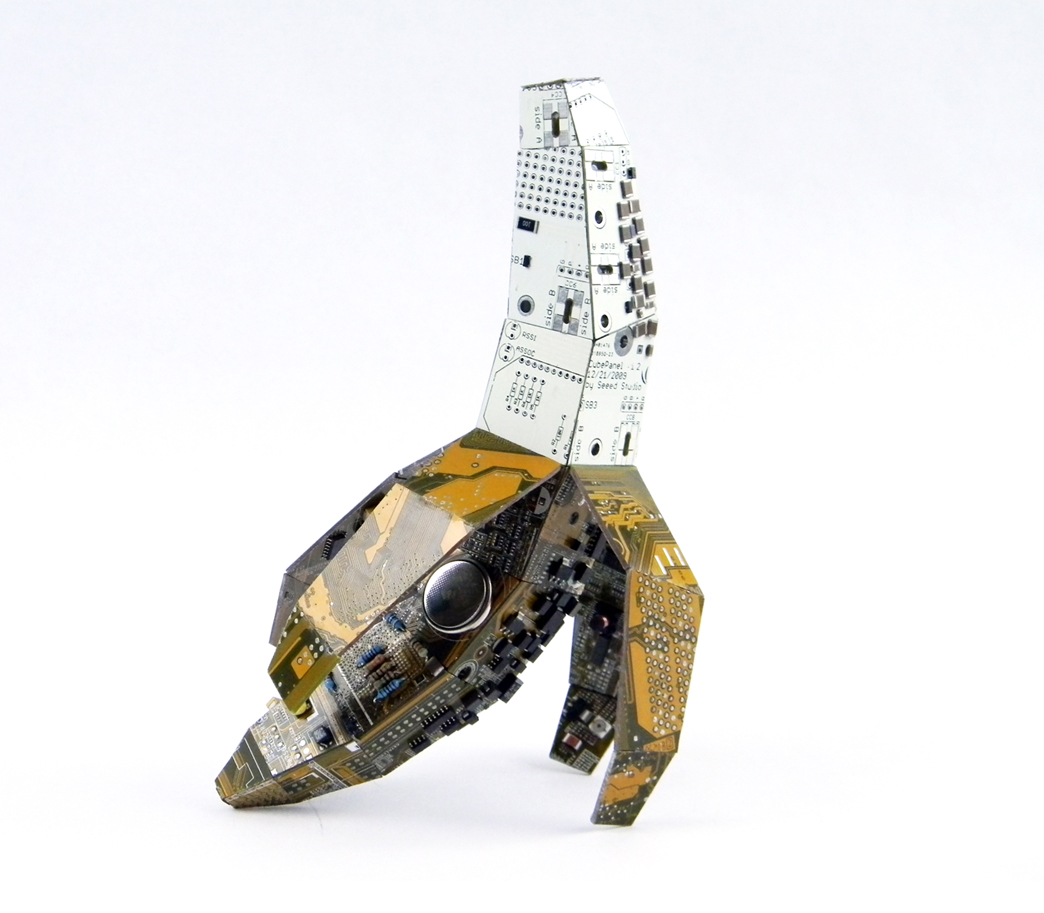
Alright, circuit board shoes probably aren’t that comfortable, or useful, but we did find a like to the works of [Steven Rodrig], an artist who works in the medium of PCBs. The recycled circuits don’t do anything, and that’s giving us a few ideas on how to improve a digital banana.


Ask Hackaday: Did you catch the Grammys?

Although award shows aren’t necessarily our thing, [T. D.] sent in something that piqued our interest. His friends recently got back from the Grammy awards where they witnessed thousands of LED bracelets blinking in time to a performance by Coldplay. A little bit of YouTubing pulled up this video that demonstrates the effect (because that video will probably be taken down shortly, just pick something from this link).

[T.D.]’s friends brought one of these bracelets back with them and like a good Hackaday reader, he cracked it open. This is the precious board pic that [T.D.] sent in. We’re pretty confident that the IC is an ATMega48PA, but beyond that we’re not quite sure how these bracelets can, “light up and flash at precisely the right time” as [T.D.] puts it.

From what we saw on the Grammy broadcast, it’s possible these bracelets merely flashed whenever the user clapped their hands. A circuit that simple doesn’t require a microcontroller, so we’re left wondering what the heck is going on here. If you’ve got an idea of how these choreographed light display bracelets work, drop a note in the comments.

EDIT: Commentors have pointed out these wristbands are called ‘Xylobands.’ There’s a great video of these wristbands in action at the 2011 X Factor finale.

Weekly Roundup 2/18/12


In case you missed them the first time around, here are our most popular posts from the previous week:

Our most read post is one about [Ben’s] project where he created an electric motorcycle that has a range of 20 miles. This is a pretty comprehensive tutorial that goes into some good detail about what you will need to do to convert a motorcycle over to electric.

Coming in at second place is [dmw’s] project where they created their own keyboard from scratch. We’re not too sure about the choice to stick the space bar(s) up in the corners but otherwise it looks like a really nice build.

Are you one of *those* people who likes to make the presents that they give as difficult as possible to open? Our #3 post of the week is one project that you should definitely check out. In this post, [Neowinian^2] shows how he and some friends encased some wedding cash inside of a giant cube of sugar!

Have you always wanted to say that you took some classes at MIT but were caught by the little technicality that you didn’t live in Boston? Fret no more my friend, MIT has just announced an online class program. You won’t be able to get a MIT degree remotely quite yet but this is a step in that direction.

Finally, we get to another keyboard project. This keyboard is a programmable keyboard that almost looks like the keypad on the end of an accordion (plus some other goodies). This keyboard was built by [Tim Tyler] and is designed to allow you to take full advantage of your thumbs instead of banishing them to the space bar.

Control a playlist with your mind

Because switching apps to change a song is such a taxing ordeal, [Oscar Celma] and [Ching-Wei Chen] decided to use their collective brainpower to change Last.FM playlists with their minds. They call their project Buddhafy, and it works by taking off-the-shelf EEG hardware and tying it into music streaming APIs.

For the build, the guys used a NeuroSky MindWave to read alpha waves inside [Oscar]’s head. The data from the MindWave was passed into a Python script that sends requests to the Last.FM and Spotify APIs. High alpha waves in brain wave patterns correspond with concentration or a deep meditative state. If [Oscar] concentrates very hard, he’ll be rewarded with calm and relaxing tunes. If [Oscar] loses focus, the music changes to the best song ever written.

The guys put up the slides from the presentation they gave at MusicHackDay in San Fransisco this last week. There’s also a video of their build in action; you can check that out after the break.

[Read more…]

Edge-lit Nixie tube is sheer brilliance

It’s not often that we see something so brilliantly simple we’re left reaching for our checkbooks while wondering exactly how we never though of that before. [Jürgen]’s edge-lit Nixie display is one of those builds.

[Jürgen]’s modern take on a Nixie display uses ten laser-engraved pieces of acrylic to emulate a Nixie numerical display. In the base of the display are 10 LEDs, each shining onto the side of a piece of acrylic. When an LED lights up, you can clearly see the corresponding number. Edge-lit displays are old hat, but talking about the possibility of an RGB Nixie-style display is really neat.

The build was inspired by an antique edge-lit display that performed the same function as the ever-popular Nixie tube with 10 miniature light bulbs and light pipes. The ancient edge-lit displays came in a rectangular enclosure that worked very well for panel-mount uses, but [Jürgen] stuck to a more traditional cylindrical orientation. All we want to know is when a manufacturer in China is going to start building these. Check out the demo of the edge-lit Nixie after the break.

[Read more…]

Wedding gift fail has happy couple cursing your name

[Superluminal] received an invite to his friend’s wedding. He got together with some mutual acquaintances to take up a collection as a wedding gift. But as things go, a suitable present couldn’t be found. The pooled money itself ended up being the gift, but apparently a greeting card with a money pocket inside of it wasn’t good enough. The group decided to encase the coinage in a block of sugar that doubles as a lamp.

Now as with many well-meaning projects this started out with a rendering of what the final product would look like. That image came out great, with a high-gloss dark amber cube lit from the bottom with the coins suspended throughout catching a bit of a glint. They bought 43kg (almost 100 pounds) of refined sugar, and made a base/mold combination out of sheet metal. A lot of induction cooking went into producing thick syrup that could be poured into the mold. The problem is the final product is basically opaque. Not a sign of the 300 Euros within.

But don’t feel too bad for the groom and his bride. The image above shows him trying to get at the prize. He must do some hacking himself because he has a pressure washer, jack hammer (or is that big drill?), humongous cold chisel, and sizable hatch already at his disposal.

We can’t help but wonder if a heat gun could have polished the sides of the cube and helped add translucence?